

The Top 8: What Shipowners Should Watch in 2026

According to Veson Nautical’s 2025 End-of-Year Market Report, a report which breaks down prevailing trends in all major oceangoing shipping sectors globally, these are the prevailing trends shipowners should watch in 2026.1. Routing Normalization vs. Geopolitical RealityMuch of 2025’s earnings strength—especially in containers, crude tankers and dry bulk—was driven by longer voyages around the Cape of Good Hope. Any sustained return to Suez transits in 2026 would compress ton-mile demand quickly. Owners should plan for volatility rather than assume a clean reversion to pre-Red Sea norms.2.
Shipping Full Steam Ahead: What '25 has set up for '26

After several years of volatility, 2025 became the year the global shipping markets began to reset. Not collapse—but recalibrate.According to Veson Nautical’s 2025 End-of-Year Market Report, the past year was defined by persistent geopolitical disruption, tightening environmental regulation and growing uncertainty over future fuel pathways. Red Sea instability continued to distort global trade flows, FuelEU Maritime and EU ETS added cost and complexity, and owners across nearly every sector adopted a more cautious stance toward fleet expansion.As the industry enters 2026…
MSC Leads in Fleet Value

Using data from VesselsValue, a Veson Nautical solution, Rebecca Galanopoulos has analyzed the global container fleet, finding Swiss based MSC currently owns the most expensive fleet with a value of $49.6 billion.This company is also the largest in terms of vessel numbers with a total of 707 vessels, of which 584 are live and 125 on order.The vast majority of this fleet is in the container sector with Panamaxes and Post Panamaxes accounting for around half of this segment. Within the orderbook…
Turbulent First Half of 2025 Echoes Across Global Shipping, Veson Nautical Reports

New U.S. tariffs and escalating global trade tensions have reshaped vessel markets in the first half of 2025, curbing investment in some sectors while accelerating strategic orders in others, according to the Half-Year Market Report by Veson Nautical, a provider of maritime freight management solutions and data intelligence.The report states that U.S. trade policy changes hit vehicle carrier markets particularly hard, contributing to a 44% drop in charter rates for standard 6…
Maturing Dry Bulk Fleet Ill-Equipped for Future
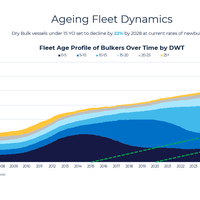
The global dry bulk fleet is facing a sharp contraction in younger, more efficient tonnage, with the supply of vessels under 15 years of age projected to fall by 22% by 2028, according to new analysis shared by Oliver Kirkham, Senior Valuation Analyst at Veson Nautical, a global leader in maritime freight and fleet management solutions.Speaking at the 2025 Marine Money Week in New York, Kirkham told delegates that the anticipated drop in younger dry bulk tonnage reflects a structural shift brought on by the historical imbalance in newbuilding activity…
Veson Nautical: US Port Fees May Disrupt Dry Bulk Trade and Vessel Availability
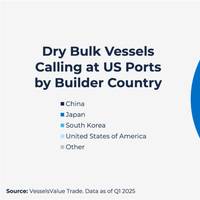
Recent discussions on tariffs have largely overlooked the potential implementation of the Office of the United States Trade Representative (USTR)’s port fees on Chinese-built vessels. This fee, which could reach up to $3.5 million per port call, varies based on the vessel’s origin and the owner’s fleet composition. Given that typical US port calls cost a maximum of $80,000, this fee could significantly impact import and export volumes.According to VesselsValue trade data, there were 3,150 dry bulk port calls in the US in Q1 2025, involving 1,609 dry bulk carriers.
Veson Nautical: Three Impacts of the IMO’s New Fuel Intensity Target on S&P Activity
The International Maritime Organization (IMO) recently hosted the 83rd meeting with the Marine Environmental Protection Committee (MEPC 83), resulting in a new fuel intensity target, which is set to come into force no later than March 2027.This new regulation is similar to the Fuel EU regulation enforced this year, but with global fleet coverage. The major effect of this new IMO GHG regulation will be to enforce a financial penalty for using cheaper, carbon intensive fuels like Heavy Fuel Oil (HFO)…
Veson Nautical: Orders For Dry-Bulk Vessels Falldry b by 26% Y-o-Y in Q1
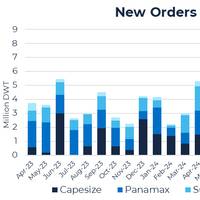
Global economic uncertainty and a cooling of the market has seen newbuild orders for dry-bulk vessels fall by 26% year-on-year according to Hongbeom Park, Head of Korea for global Veson Nautical, a global leader in maritime data and freight management solutions.Speaking at Veson Nautical’s Seoul Forum, Park said uncertainty around the future of fuels, historically high newbuild prices and the price premium for dual-fuel vessels was driving the fall.“The market is slowing in the newbuild sector and orders falling by over a quarter is a reflection of that,” Park said.
South Korea's Orderbook Tops $138 billion
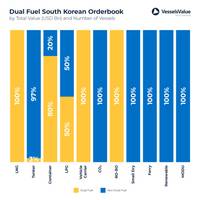
Veson Nautical has used VesselsValue data to confirm that South Korea’s orderbook has now topped $138 billion.The LNG sector is the most valuable, worth $71.3 billion and accounting for around 52% of the total South Korean orderbook value. This sector also has the highest volume of orders with 276 vessels on order.Container ships rank second with a market value of $35.6 billion, equating to a share of about 26% and 184 vessels on order. The LPG ranks third with a value of $14.9 billion and 129 vessels on order, closely followed by the tanker orderbook which is valued at $14.7 billion.
China-U.S. Clash has Shipping Companies Heading for Cover
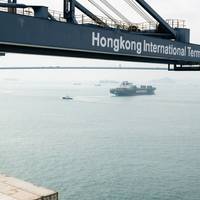
Some shipping companies are discreetly moving operations out of Hong Kong and taking vessels off its flag registry. Others are making contingency plans to do so.Behind these low-profile moves, six shipping executives said, lie concerns that their ships could be commandeered by Chinese authorities or hit with U.S. sanctions in a conflict between Beijing and Washington.Beijing's emphasis on the role of Hong Kong in serving Chinese security interests and growing U.S. scrutiny of the importance of China's commercial fleet in a possible military clash…
Veson Nautical, Cargill Expand Partnership

Veson Nautical and Cargill announced the Strategic Technology Agreement, expanding their partnership to accelerate digital transformation in the maritime sector. The agreement provides Cargill's Ocean Transportation business with a broad range of access to the Veson portfolio, including its data intelligence capabilities and AI-enabled collaborative workflow solution Shipfix. This builds on previous utilization of the Veson IMOS Platform. Cargill aims to simplify its technology ecosystemwhile driving efficiency, sustainability and innovation.
Qatar Gas Tops Regional Shipowner Ranking
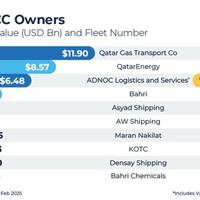
Qatar Gas Transport Co is currently the top Gulf Cooperation Council (GCC) company in monetary terms, with a live and on-order fleet value of $11.9 billion, reports Rebecca Galanopoulos of Veson Nautical.Based on VesselsValue data, the fleet consists of 36 live LNG and LPG vessels with a further 30 on order. Qatar Gas also placed the highest value newbuilding order in February 2024 with their investment in 15 large LNG vessels, scheduled to be built at Samsung and contracted for…
New, Old Vessel Speed Disparity Splits Bulker Fleet
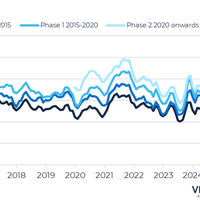
The global bulker fleet is facing a significant slowdown, driven by a combination of factors that are not only causing a decline in average speeds but also setting the stage for the emergence of a two-tier market, according to Veson Nautical.A new report: ‘Why is the bulker fleet slowing down? The impact of an aging fleet in the era of efficiency’ says that aging vessels, stricter emissions regulations, and evolving market dynamics are all factors in the lower average speeds being witnessed.The report cites data that suggests that older vessels…
Veson Nautical Opens Dubai Office

Veson Nautical (Veson) opened a new office in Dubai as part of an enhanced commitment to one of the world’s most important shipping hubs.This expansion is aimed at bringing Veson closer to its growing regional client base and reinforcing its role in shaping the future of maritime technology and data solutions in the region.Veson CEO John Veson traveled to Dubai to open the new office, and the occasion was marked by the company staging the inaugural ‘Veson Nautical Dubai Forum & Networking Event.’ Held at the Sofitel JBR hotel…
Chinese Vessel Orders Shoot Beyond $123B, Veson Nautical Finds
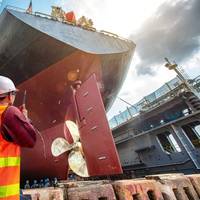
Veson Nautical, a provider of maritime commercial management and trading software solutions, has reported that the Chinese newbuilding vessel orderbook has topped $123 billion in 2024, with container ships making around 38% of total vessel orders.Using VesselsValue data, Veson Nautical has summarized the Chinese orderbook by top Chinese ordering companies and insight into the ships currently being built at Chinese yards.Of the top Chinese companies ordering vessels last year, China Merchants Shipping ranks first, with contracts agreed for 28 new vessels, worth $4.4 billion.
Ranking & Reporting the World's Top 10 Vessel Owning Nations
In the ever-evolving world of maritime trade, ship ownership is a key indicator of economic influence and global commerce. As we enter 2025, Veson Nautical offers its Top 10 Ship Owning Nations, offering a detailed analysis of fleet values and industry shifts. This year, China has surged to the top, overtaking Japan in total fleet value, while geopolitical events and shifting market dynamics continue to shape the rankings.Let’s take a closer look at the global giants of ship ownership and the forces driving their dominance.1.
Box Sector bullish after stellar 2024, but risks abound in 2025
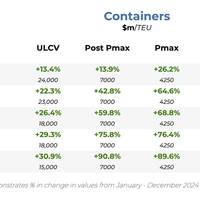
The time charter (TC) rates for Post Panamax container vessels rose by 111% year-on-year (y-o-y) in 2024, hitting 73,330 USD/Day, and has led to a huge uptick in newbuild orders and a slowdown in demolitions according to Veson Nautical’s ‘2024 End- Of-Year-Report’.The report states that the bullish market conditions for the container sector are reflected in the TC rates as well as the 76% y-o-y increase in new ship orders which witnessed 321 deals including options, compared to 182 orders in 2023.“The container market experienced remarkable growth over the past year…
Spire's Sale of Ship Tracking Arm alarms Users
French maritime data analytics platform Kpler wants to buy ship tracking company Spire Maritime, whose satellite data is a vital resource for oil traders and shipping companies, but some Spire customers fear Kpler will cut them off and have raised antitrust concerns to U.S. authorities, sources familiar with the matter say.The $241 million deal announced on Nov. 13 would give Kpler control over Spire's satellites and maritime Automatic Identification System (AIS) data stream, which tracks ships globally, particularly in the open ocean, with a refresh rate of every 15 minutes.This capability is unmatched by competitors, including Orbcomm…
'24 in Review: Container Vessel's Steams Ahead, LNG Lags
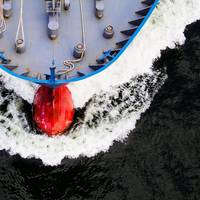
The last 12 months has seen values rise to near-record levels across several sectors of the shipping industry, fuelled by the post-covid shipping boom and a strong newbuild market.The report states that the newbuild market experienced continued growth, with a notable rise in orders, particularly in the Post/Panamax and Capesize sectors. Chinese dominance in both ordering and shipyard production remains a defining trend, further consolidating their position in the bulker industry.Container…
Car Carrier Vessel Market Outlook for '25 is Bearish
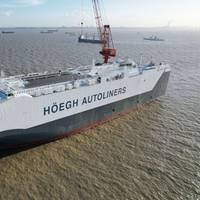
Political winds blowing a raft of new tariffs and incoming supply uptick suggests a volatile 2025 Bearish sentiment crept into the car carrier market in June after the European Union (EU) announced increased import tariffs for Chinese-made electric vehicles (EVs) up to as much as 45.3%. The EU tariffs, which came into play in November for a period of five years and were increased following an investigation into Chinese state subsidies to domestic car manufacturers, are weighing…
Container Shippers Mitigating Green Transition Risks with Dual-Fuel Vessel Orders

Container shipping companies like Maersk, CMA CGM and COSCO have ordered hundreds of new vessels in recent years meant to help their industry slash greenhouse gas (GHG) emissions to meet rising demand from customers and regulators around the globe.Their order books, however, reflect uncertainty over which of a wide array of so-called green fuels will become the standard in the decades to come, and whether supplies will be cheap and abundant enough to keep their fleets in motion.Decarbonizing…
Container Vessel Orders Mark Over 50% Rise in 2024

Orders of new container vessels are up by approximately 52% year-on-year with 254 new contracts placed in 2024, compared to 167 in the corresponding period of 2023, according to a new report by Veson Nautical's data intelligence arm VesselsValue.The report, titled ‘Golden Age: Container shipping’s post-covid boom continues’, states that in addition to the huge uptick in orders, 2024 has seen 362 new container vessels entering the market with a further 169 to be set to be delivered in the last few months of the year.“Thanks to the post-covid container boom…
Greek Shipowners Betting Billions on Gas

Greek shipowners have spent an unprecedented $18 billion on newbuild gas vessels since 2021 as companies diversify their portfolios away from traditional tanker, bulker and container asset classes according to new research by Veson Nautical's data intelligence arm VesselsValue.Approximately $13.8 billion of the figure has been spent on 59 liquefied natural gas (LNG) vessels, and approximately $4 billionn on 41 liquid petroleum gas (LPG) vessels, according to the new report, ‘Greek Speculative S&P Investments’.